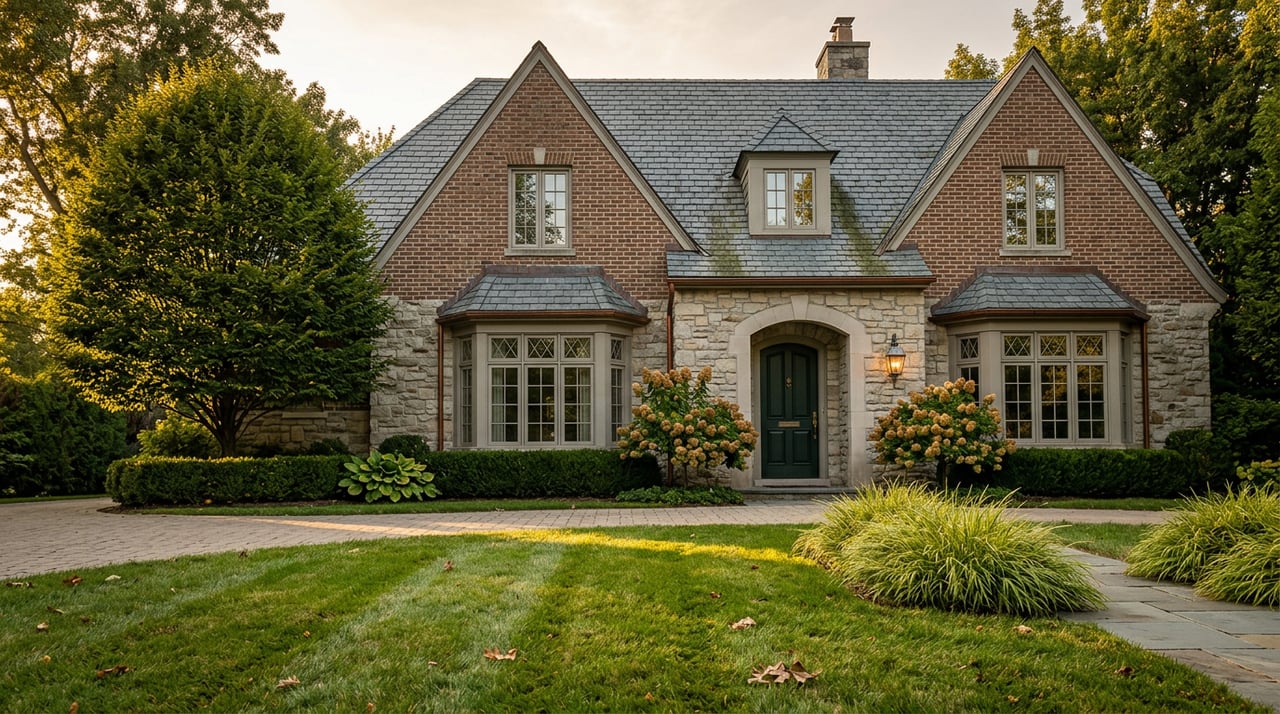
Why Devon's Emptiest Landmark Finally Makes Sense
September 3, 2026
September 3, 2026
Drive west on Lancaster Avenue past the Whole Foods in Devon and you pass a building most residents have stopped noticing, which is exactly the problem. The mosaic tile on the facade is still there. So is the gazebo out front, built to resemble a Persian kushk, the kind of detail nobody puts on a strip mall. For close to two decades, the building has sat empty on one of the most valuable stretches of real estate on the Main Line, a fact that says less about the location than it does about what it actually takes to bring a building this size back to life.
That building is finally filling up. But the reason it took twenty years, and the reason four different restaurant concepts are now moving into one structure instead of one, tells you something about Main Line real estate that a simple "new restaurant coming soon" post would skip past entirely.
The complex at Lancaster Avenue and Berkley Road opened in the fall of 1999 as the passion project of a Main Line physician who wanted to showcase the cuisine of his childhood in Iran. On the first floor sat La Jonquille, a French restaurant with 30-foot ceilings and, in the words of one restaurant critic at the time, a chandelier the size of something you'd find at Versailles. Upstairs was Shiraz, a Persian restaurant and banquet room decorated with hand-hammered murals and hand-painted tile. The whole project reportedly cost around $10 million to build, close to double that in today's dollars.
It didn't last. A small kitchen fire and management troubles closed the restaurants in 2001. Shiraz reopened in fits and starts starting in 2003, then closed for good a few years after that. Parts of the building were eventually carved up into office space. The rest just sat there.
Here's the part that a passing glance at the building doesn't tell you. The property is genuinely large: a two-building, roughly 32,000-square-foot complex, and for years the asking price was believed to be as high as $13 million. That combination, size and price, is exactly why nobody bought it.
A single restaurant, no matter how ambitious, only fills so many covers a night. It doesn't matter whether the dining room seats 60 or 200. Once a restaurant hits its practical seating capacity, the extra square footage in a 32,000-square-foot building isn't generating more revenue. It's just carrying cost. That math is why a building this size, on a stretch of Lancaster Avenue surrounded by high-end retail and restaurants, could sit vacant for twenty years even as demand for Main Line dining stayed strong. The building was too big for one restaurant to justify.
What actually made the site valuable wasn't the dining rooms. It was the parking lot. The property comes with at least 130 spaces, a rarity commercial broker Paul French, who represented the seller in the eventual sale, pointed to directly.
"To get that amount of parking on the Main Line is almost impossible."
That single fact reframes the whole property. A 130-space lot doesn't just support one restaurant's dinner rush. It supports several, running at the same time, without anyone circling the block for a spot. The building didn't need a buyer looking to open a nicer restaurant. It needed a buyer willing to stack multiple concepts into one address and split the fixed cost of that real estate across several revenue streams instead of one.
That buyer turned out to be Rich Kim, an owner of Salt Korean BBQ in North Wales along with Sang Hi, a Chinese-Korean noodle house in the same town. Kim and his partners closed on the Devon property in 2025, and the plan he's executing is not a single upscale restaurant. It's four concepts sharing one address.
Kim has cited two Michelin-starred New York restaurants, Oiji Mi and its sibling bōm, as inspiration for the omakase concept, though he's said his version will stick to Korean dishes exclusively. All told, the four concepts are expected to employ 70 to 80 people, full and part time, a staffing footprint that only makes sense when you're running four kitchens instead of one.
Some of the original decor may survive the renovation. Kim has said he isn't sure whether he'll keep the padded fabric walls or that oversized chandelier from La Jonquille's dining room, but has been clear about the overall direction: "we're going to flip it upside down." The mosaic tile and the kushk-style gazebo out front, both landmarks residents have looked at for two decades without a restaurant behind them, are staying.
It's worth putting this next to what's happening less than a mile away. Devon Yard, the Anthropologie and Terrain complex built by URBN on the former Waterloo Gardens site, took a completely different path to revival. URBN demolished what was there and built five new structures from scratch on a six-acre parcel, all under one ownership and one cohesive brand vision, with Terrain Cafe and Amis Trattoria as the anchor tenants.
Kim's project is the opposite kind of bet. He's not building new. He's retrofitting a structure that was purpose-built for someone else's French and Persian dining concept a quarter century ago, and the only way to make that math work was to split it four ways. Both projects are reviving the same stretch of Lancaster Avenue. Neither approach is interchangeable with the other, and the difference tells you something about why some vacant Main Line properties get snapped up quickly while others, like this one, sit for years waiting for the right kind of buyer.
Anyone who has been watching this building's slow reopening has already seen the projected date move at least twice. Kim told a reporter in April 2025 that he hoped to open within eight months, which would have put the debut around the end of that year. By the time the sale was formally announced that August, the timeline had shifted to spring 2026. As of a Main Line dining roundup published in March 2026, the projection had moved again, to late summer 2026, the window we're in right now.
That drift isn't a red flag. Renovating a 32,000-square-foot complex with decades of deferred maintenance and four separate kitchen builds simply doesn't run on the same clock as opening a single new storefront. Each of those revised dates reflects real construction milestones, not marketing spin, and the pattern is useful information on its own: if you're watching for the doors to open, betting on early fall rather than any specific date on an old press release is the safer read. The first-floor concepts, Salt Korean Barbecue Steakhouse and the fast-casual counterpart, are the more likely first arrivals, with the omakase room and the second-floor Yugo concept probably following once the ground floor is up and running.
For a building that residents have driven past without a second thought for twenty years, that's worth knowing before the first table gets seated.
Whenever you're ready to talk about what's happening in Devon, or anywhere else on the Main Line, Brent Lyle Erickson is glad to help. Let's Connect.
Stay up to date on the latest real estate trends.
Whether you’re buying your first home, selling a property, or exploring investment opportunities, Brent Erickson offers the patience, knowledge, and commitment needed to help you reach your real estate goals with confidence.